
adminbackup

Categories
Uncategorized

Why Spot Trading Altcoins Demands Better Exchange Security (and How Traders Actually Win)

Whoa! This whole altcoin scene moves fast. Really fast. At times it feels like you blink and a token you loved is either mooning or ghosted. My instinct said the same thing for years: trade the momentum, manage risk—end of story. Initially I thought that was enough, but then a couple of close calls taught me otherwise. Somethin’ about rallying into liquidity gaps and logging into an exchange on public Wi‑Fi made my gut tighten. I’m biased, but exchange security is the quiet risk you ignore until it’s not quiet at all.

Here’s the thing. Spot trading altcoins isn’t just strategy and TA. It’s custody, connectivity, authentication, and often the human stuff—password reuse, sloppy 2FA, phishing clicks. Hmm… scary? Yes. But manageable. On one hand you can rely on a big brand and hope their ops are flawless. On the other hand you can assume responsibility for your own security posture and reduce single points of failure. Though actually—let me rephrase that—it’s rarely binary. You need both: careful exchange selection plus personal controls that are practical in the real world.

Let me walk through what I learned the hard way, what the pros do differently, and some concrete steps you can take today. No fluff. No silver bullets. Just a pragmatic mix of psychology, process, and tools that lowers the odds of tragic loss when you trade spot altcoins.

A trader at a laptop, screens with charts and a padlock icon overlay

From login to withdrawal: the weak links

Okay, so check this out—most security failures start at the edges. You do a quick search for “upbit login” sometimes to pull up an exchange and bam—phish sites pop up. If you want the official entry page, bookmark it and use that. Or use a reputable password manager to store the real address. For convenience, here’s the official-looking link I use when teaching clients: upbit login. Be careful though—one link isn’t the whole defense.

Short story: attackers go after authentication and withdrawal processes because that’s where value moves. Medium story: many traders reuse credentials across exchanges, social platforms, and email. Longer story: attackers exploit third-party weak points—API keys left with excessive permissions, staff at exchanges with inadequate internal controls, or browser extensions that leak session cookies—so you need layered defenses that address each vector.

Here are the typical weak links I see every week: shared passwords, SMS 2FA misuse, API keys with withdrawal rights, unvetted browser extensions, and complacency around account sessions on public devices. That list is not exhaustive, but it’s a good start.

I’m not going to sugarcoat it. Some practices feel annoying. Turning on hardware 2FA for every account feels cumbersome. But it’s very very important. Do it.

Practical checklist for secure spot trading

Start simple. Seriously? Yes. Complexity kills adoption. If you don’t adopt the controls, they remain theoretical. So begin with things you will actually do.

  • Use a unique, strong password per exchange and store them in a password manager. No exceptions—please.
  • Prefer hardware 2FA (U2F/WebAuthn) over SMS codes. If you must use app-based 2FA, back up your seeds offline.
  • Limit API keys: create a separate API key for bots with only the permissions required (read/trade, no withdrawals). Periodically rotate keys.
  • Whitelist withdrawal addresses when the exchange supports it. Combine that with withdrawal confirmation emails and additional auth layers.
  • Keep minimal funds on exchanges. For spot trading you need balance, yes—just not your entire stack. Move longer-term holdings to cold storage.
  • Audit browser extensions and remove anything you don’t actively use. Phishing often rides in via extensions.
  • Monitor sessions and be ruthless about active logins on unfamiliar devices.

On one hand this feels like a checklist. On the other, it’s an operational culture shift—you’ll need to make it habit. Initially I slipped. Then I automated where I could. Now, some steps are second nature.

Working through contradictions: you want quick access to capitalize on moves, but you also want slow, deliberate security. The trade-off is situational. For high-frequency or arbitrage-style operations, compartmentalize accounts: one “hot” account for instant action, one “cold” for reserve capital. Not perfect, but it works.

Choosing an exchange: signals that matter

Most Korean and international traders I talk to prioritize liquidity and fees. Those are necessary, but insufficient. Look at operational transparency, proof of reserves, patch timelines, and how the exchange handles incidents. Does the exchange publish audits? Do they disclose insurance policies and the exact scope? Do they have a history of fast patching and clear communication when breaches happen? These things reveal priorities.

Also check whether the exchange supports modern auth standards like WebAuthn. If they do, that’s a good sign they’re thinking about long-term security. If they still require only SMS for account recovery, that should make you pause. My instinct said: move away. Then I validated it with others’ stories.

One more nitty-gritty: read the withdrawal policy and the transaction queue descriptions. It sounds boring, but in an incident a transparent queue and well-documented escalation paths matter. (Oh, and by the way: customer support response times and the availability of a dedicated security contact—those are underrated.)

Spot trading tactics that respect security

Trading altcoins on the spot market can be opportunistic. But opportunism without discipline is a recipe for emotional losses. So pair strategy with security-aware workflows.

Keep three accounts of liquidity: main trading account, execution-only account (for algos or bots), and custody account. Each has different risk tolerances and controls. The execution-only account should be heavily sandboxed with strict API scopes. The custody account should require manual withdrawals, additional approvals, and infrequent use. This compartmentalization reduces blast radius when something goes wrong.

Also, document your emergency playbook. If an exchange reports a breach, what do you do? Which accounts do you freeze? Who do you notify? What’s the communication protocol? Systems for trading can be rebuilt. Trust and funds are harder to recover. Build a playbook—test it occasionally.

I’m often asked: “How much capital should I keep on an exchange for spot trading?” There’s no single number. My guideline: capital that supports your near-term trading plan for 7–30 days, plus a buffer for execution errors. That forces discipline and reduces temptation to hoard large balances online.

On-chain hygiene and withdrawal practices

Moving funds off-exchange is a transfer point that needs rituals. Always use a fresh address when feasible, or at least an address pattern that makes tracing straightforward for your own audit trail. Verify withdrawal addresses twice: once when you paste, once when you confirm. If your exchange supports address labelling and whitelisting, use both.

For larger transfers, do a test transfer first. It costs time and some fees, but it’s worth it. If you’re consolidating funds, stagger the transfers to avoid large single waves that attract attention—both in the blockchain sense and the attacker sense.

Also, remember chain selection. Some altcoins exist on multiple chains. Sending across the wrong chain kills funds. I’ve seen it. You don’t have to be the person who learns that lesson in public.

Common questions traders ask

Is cold storage always better than leaving funds on an exchange?

Mostly yes for long-term holdings. Cold storage minimizes attack vectors but reduces liquidity. For spot trading, keep what you need on exchanges for immediate trades and move the rest to cold storage. I’m not 100% strict here—context matters—but this balance reduces risk without killing your ability to trade.

What 2FA should I use?

Hardware 2FA (U2F devices like YubiKey) when supported. If not, app-based TOTP with secure backup. Avoid SMS-based 2FA for critical accounts. Seriously—SMS is too easily hijacked through SIM swaps or social engineering. Use more robust methods where available.

How do I recognize phishing for exchanges?

Check the domain, never follow search results blindly, and verify SSL certificates in the address bar. Bookmark official pages. Beware of lookalike domains and tiny misspellings (somethin’ like “upbít” or “upbit-login[dot]xyz”). When in doubt, reach out to the exchange via known channels. Trust but verify—repeat if needed.

Alright—so what’s the final posture? Not final, actually. It’s iterative. You adopt better habits, update when threats evolve, and accept some friction for security. If you treat security like an afterthought, you pay with either lost funds or time recovering them. Both suck.

I’ll close with a pragmatic nudge: implement one improvement this week. Rotate a high-risk API key. Enable hardware 2FA on one exchange. Move one large holding to cold storage. Small steps compound. You’ll feel better, and you’ll trade better because anxiety and distraction drop. Seriously—trade with less noise and more conviction.

Categories
Uncategorized

How I Size Risk: Market Cap, Yield Farming, and Price Alerts for DeFi Traders

I was mid-scroll when I noticed the market cap labels on a token dashboard. Whoa! They said a $200M market cap but the liquidity felt much smaller. Initially I thought the numbers were straightforward, but then I realized the project was reporting fully diluted valuation instead of circulating market cap, which throws off quick risk calculations. That little mismatch made somethin’ feel off and my trading plan changed.

Really? On one hand the token’s circulating supply was small. On the other hand liquidity sat in a few wallets, which raised flags. If you don’t adjust for wallet concentration and staking locks, you can wildly overestimate how tradable a market cap figure actually is, and that leads to bad entries or exits. My instinct said check the pools before risking capital.

Hmm… Market cap alone rarely tells the full DeFi story. Circulating supply, token lock schedules, and concentrated holdings all matter. When you layer yield farming on top of that, the effective risk changes again because emissions can swamp price or provide strong sell pressure as rewards mature and participants harvest rewards. So yield farming looks juicy until you model reward decay and impermanent loss.

Whoa! Yield figures are often APR not annualized APY, and many dashboards don’t include fees or compounding assumptions. Initially I thought high APRs were automatic profits, but then I simulated rewards plus slippage and realized that once you include compounding intervals, gas, and the token’s market depth, the realized returns can be half what the headline figure promises. Actually, wait—let me rephrase that: headline APYs are marketing. Watch reward halving schedules and token emission curves closely, because they shift yield expectations.

Here’s the thing. Assess the farm like a business, not like a free lunch. Ask: who pays rewards, where do they vest, and what stops a dump. On one hand incentives can bootstrap liquidity and create profitable early returns, though actually those same incentives can attract mercenary capital that leaves when emissions slow, creating big drawdowns for passive LPs who didn’t account for timing risk. I’m biased, but tokenomics modeling should be your first step before APY-chasing.

Wow! Liquidity depth matters more than market cap in many swift moves. Check pool sizes and depth at small and large move levels. If a token has a $10M market cap but only $100k in the main pool, then a serious buyer or seller will move price exponentially and the risk profile is entirely different than the headline would imply. I use charting plus on-chain explorers to approximate realistic execution cost.

Seriously? Price alerts are your friend when markets go parabolic or crash. Set multi-layer alerts: percent moves, volume spikes, and liquidity pool balance changes. Auto-sells or limit orders can help, though remember DEX execution depends on pool state at the moment and front-running risks or MEV can change outcomes, so automation isn’t bulletproof. I recommend small test trades and manual confirmation for large orders.

Hmm… Tools help, but you need to know what each number actually measures. For real-time token metrics I check the dexscreener official site and cross-reference with on-chain data. Dexscreener gives live pair data, price charts, and quick liquidity snapshots, yet you should still pull contract details and read vesting schedules before trusting any long-term thesis because the UI won’t catch everything. Once I added these checks to my routine I avoided several rug scenarios.

Dashboard screenshot showing market cap, liquidity, and farming APY

Practical checklist I run before farming or adding liquidity

I’ll be honest. Risk filters are simple but you must run them every time. For example, before farming I always check token locks, owner privileges in the contract, recent token transfers that indicate accumulation, and whether the deployer renounced ownership, because these details predict whether the project can later change fees or drain liquidity. Sometimes a trade feels right emotionally, but the on-chain facts disagree. Trust the data, not the hype or FOMO.

Here’s what bugs me about the space: people chase APY screenshots without modeling exits. Okay, so check this out—run a slippage simulation for your intended trade size, then stress-test the farm by modeling reward decay over the next three months with conservative compounding. My instinct said do that years ago, and it saved capital. Also—very very important—always assume mercenary LPs can leave overnight.

FAQ

How should I interpret “market cap” for small-cap tokens?

Use market cap as a rough attention signal, not an actionable liquidity metric. Look at circulating supply, vested tokens, and the amount locked in the main liquidity pool. If the pool holds a tiny fraction of the circulating supply, price impact from trades will be huge, so scale orders accordingly and consider staggered entries.

Can I trust high APYs on a new farm?

High APYs can be legit but often they come with fast emission schedules and short-term rewards that dilute value. Check who funds the rewards, how long emissions last, and whether rewards are paid in volatile tokens. Also model fees, gas, and compounding cadence—your realized APY will likely be lower than the headline.

What price alerts should I set?

Set alerts for percent thresholds (e.g., 5%, 10%), sudden volume increases, and liquidity changes in the pool. Add an alert for significant token transfers from big holders. Combine those with a watchlist on execution-ready tools so you can act quickly if the on-chain picture deteriorates.

Categories
Uncategorized

Why Solscan Still Feels Like the Best Way to Read Solana

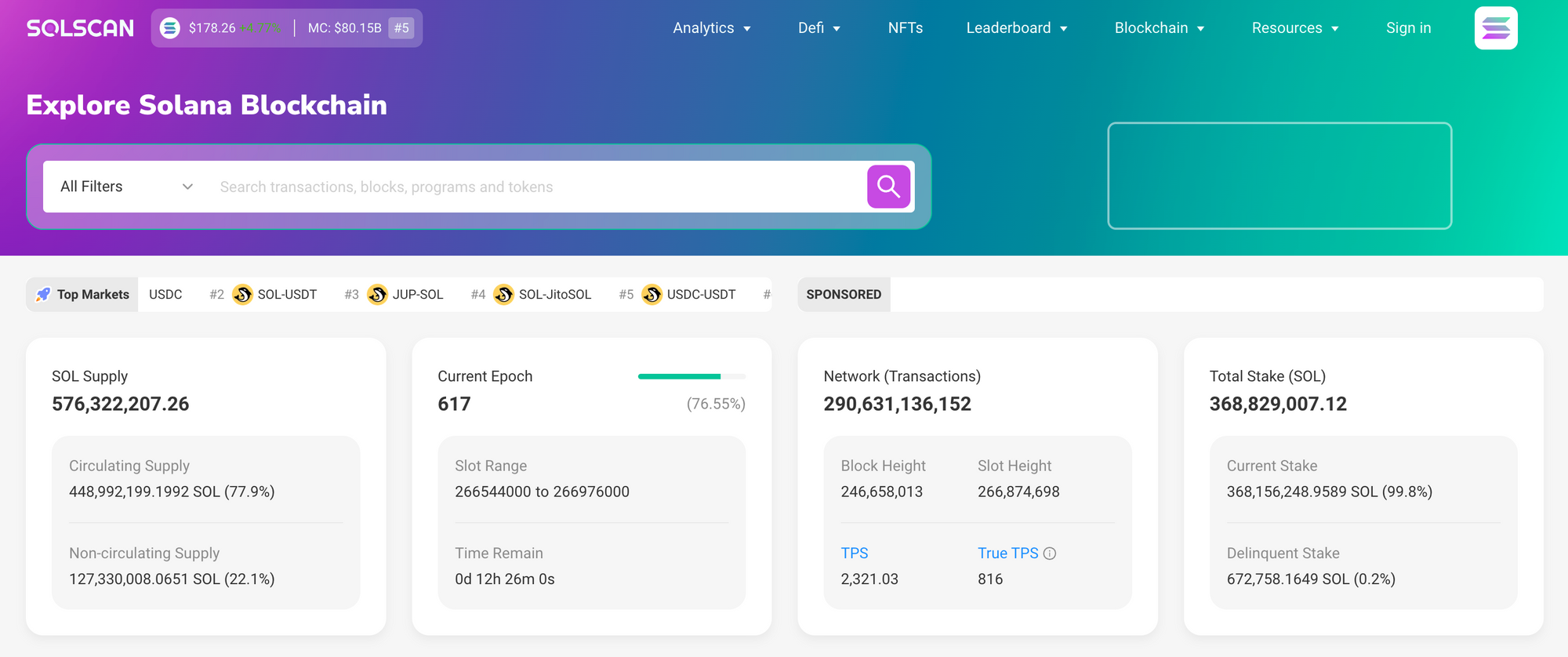
Okay, so check this out—I’ve spent more than a few late nights chasing transaction hashes across a handful of Solana explorers. Whoa! The interfaces blur together when you’re tired. But Solscan keeps pulling me back. It’s fast, it surfaces the right nitty-gritty, and—honestly—it’s the kind of tool that makes you feel like you actually understand what’s happening on-chain instead of just guessing.

First impressions matter. Really. When you land on an explorer and the search bar hides behind three menus, you bail. Solscan avoids that. It puts the essentials up front: balances, token transfers, program interactions. My instinct said “this is sensible UX” the first time I clicked around. Initially I thought all explorers would be the same, but then I realized the subtle differences—how Solscan organizes program logs, the way it highlights inner instructions, how block confirmations are displayed. Those small choices change the whole debugging flow, especially when you’re troubleshooting complex transactions.

Here’s the thing. Solana moves fast—blocks every 400ms-ish—and that speed exposes weak explorers. Hmm… some sites lag by a few seconds, others completely fail under load. Solscan scales well. It caches cleverly and shows live updates without turning the page into a slideshow. On one hand this is just engineering; though actually, it’s also a product choice. You can feel that someone prioritized developer and power-user needs.

Screenshot of Solscan highlighting a complex transaction with inner instructions

How Solscan helps with real Solana analytics

When I’m tracking a token mint or following a staking flow, I want two things: context and clarity. Solscan gives both. It groups token transfers, decodes program instructions (most of the time), and surfaces linked accounts so you can follow the money. Sometimes the decoding is imperfect—especially for newer or custom programs—and you have to do a little digging. I’m not 100% sure why every program isn’t auto-decoded yet, but the community tooling is improving fast.

A practical example: you want to audit a multi-step swap that touches Serum, Raydium, and a custom AMM. Solscan will show each instruction in sequence, with logs and pre/post balances. That makes it easier to spot sandwich patterns, front-running attempts, or weird slippage. I once found a failing transaction where a wallet tried to borrow without enough collateral—Solscan’s error logs pointed right at the program return code. Saved me, and maybe saved someone else—oh, and by the way, I reported it to the devs.

Curious about on-chain trends? The analytics views are decent for getting a snapshot—top tokens, top programs, daily volume spikes. They aren’t a replacement for a full analytics suite, but they are excellent for quick triage. My bias: the best blockchain tooling gives you fast answers without requiring a PhD in data science. Solscan hits that mark. It’s not perfect, but it’s very, very useful.

One more practical tip—if you’re ever unsure about whether you’re on an official site (phishing is real), verify the domain and cross-check with trusted sources. If you want a quick bookmark, here’s the best way to get to the explorer: solscan explorer official site. It’s a small step that saves a lot of headaches later.

Now, let me nitpick a bit. Here’s what bugs me about browser-based explorers: sometimes they hide advanced filters behind tiny dropdowns. Also, mobile views can be cramped; I often want the desktop layout on my tablet. The team is improving mobile support, but there’s room to grow. Also, occasionally token metadata is stale—names or icons that haven’t updated. It’s a minor annoyance more than a blocker… but still.

On the upside, Solscan’s developer features are solid. The transaction pages provide raw transaction data, base64-encoded instruction data, and links to common SDKs. If you’re building, this reduces friction. You can copy a transaction, drop it into a local tool, and iterate. For folks running validators or bots, those quick hand-offs matter. I found myself saving time on integration tests just by grabbing logs directly from a Solscan page rather than hunting through RPC responses.

Transparency is another point. They expose program source links when available and show verified program tags. That helps in trust-building. Of course, verification isn’t a guarantee—so still do your own research. I’m biased, but I sleep better knowing the explorer is doing some of the heavy lifting when it comes to surfacing suspicious activity.

FAQ

Is Solscan free to use?

Yes—most public features are free. There may be rate limits for heavy automated requests, so if you’re running high-frequency tooling you should use a dedicated RPC or contact their team for API options.

How accurate is Solscan’s data?

Generally accurate—data comes from Solana nodes and finalized blocks. Occasionally pending or unconfirmed transactions can show up differently across explorers, and metadata (like token symbols) can lag. Cross-check with raw RPC responses when accuracy is critical.

Can I rely on it for audits?

Use it as a first-pass tool. Solscan is excellent for triage and initial forensics, but a formal audit should include on-chain data pulled directly from validated nodes, plus source-code reviews and tests. Solscan makes the on-chain portion easier, but it’s not the only piece.

Categories
Uncategorized

Why safe IBC transfers, slashing protection, and fee-savvy txs matter for Cosmos — and how to actually do them

Okay, so check this out—I’ve been bouncing tokens across chains for years, and somethin’ about the whole process still surprises me. Whoa! The Cosmos world promises seamless IBC flows, but the reality can feel messy, confusing, and a little risky if you don’t take basic precautions. My instinct said “this will be easy,” at first. Actually, wait—let me rephrase that: I assumed wallets would handle every corner case, though that was naive. On the one hand, interoperability unlocks composability across zones. On the other hand, a wrong step can cost fees, time, or even stake via slashing. Really?

Here I’m going to walk through three tightly connected concerns for Cosmos users who care about secure IBC transfers and staking: cross‑chain interoperability best practices, slashing protection basics (for both delegators and operators), and actionable fee optimization tactics. Hmm… I’ll be honest—I’m biased toward tooling that makes life simpler. So I’ll point you to a wallet I use often, and you can judge for yourself. Check it out here.

Short primer first. IBC is a packet-based protocol. Simple in theory. Packets travel through channels, and relayers move them. But those packets have nuances: denomination traces, timeout heights, and fee requirements for relayers. That means “send” is rarely just click-and-go.

A hand holding a phone with a Cosmos network dashboard—transfer in progress

Cross-chain interoperability: practical heuristics

Start with channel selection. Pick the canonical channel between the two chains whenever possible, not some ad-hoc one set up by a random DEX. Short sentence. Channels determine how denom traces look. They also determine which relayer operators will pick up your transfer. If you pick a weird channel you may add unnecessary hops and fees, and you might end up with an IBC token that bears an unfamiliar denom prefix.

Simulate first. Seriously? Yes. Run a small test transfer before moving significant sums. One tx will tell you about gas, required timeouts, and any memo quirks. My rule of thumb: send a tiny amount, wait for the packet to pass, confirm the relayer received it. This saves headaches later. On some chains, a failed or timed‑out transfer can require manual resolution or even token recovery steps; don’t say I didn’t warn you.

Timeout settings matter. If you set overly short packet timeouts your transfer may auto‑timeout if the relayer is slow or chain congestion spikes. Too long, and your tokens could be locked in a routed path longer than you expected. I tend to set a moderate timeout and choose relayers with good uptime. Feel free to be conservative. (oh, and by the way… record your tx hashes.)

Also—pay attention to memo fields. Some chains or bridges need specific memo formatting for swaps or smart contracts. Missing that memo can result in lost funds or stuck deposits. That part bugs me.

Slashing protection — who it affects and what to do

Quick reality: slashing is most relevant if you’re staking, and there are two common causes: double‑signing and prolonged downtime. Miners—uh, validators—can be penalized. Delegators share in that penalty when the validator misbehaves. Hmm… not fun.

For delegators: diversify, but not too much. Short sentence. Spreading stake across many validators reduces single‑point exposure, but over‑diversification creates overhead and fragmentation of rewards after unbonding. Aim for a handful of well-run validators with transparent infrastructure and strong community reputations. Look for validators who run on multiple geographically separated nodes, use failover setups, and publish monitoring data. Initially I thought many small validators were safer, but then I realized concentration on trusted operators reduces slashing risk while keeping compounding simple.

Use hardware wallets for staking operations when possible. I’m biased, but hardware + Keplr-like UX gives a strong balance of convenience and security. Keep your signing keys offline if you’re running a validator. If you are a validator operator: never run the same signing key on multiple live nodes without a proper failover protocol. Double-signing is usually accidental during misconfigured failovers.

Consider slashing insurance and third‑party protection only as a last resort. There are products that promise slashing reimbursement. Read the fine print. Many require strict on‑chain monitoring and specify conditions that exclude common real‑world scenarios. I’m not 100% sure any of them cover all edge cases.

Fee optimization for transfers and staking

Fee strategies are an overlooked advantage. You can shave meaningful costs with simple habits. Short sentence. First, set sensible gas and gas price values instead of blindly accepting defaults. Use on‑chain gas estimation tools if available. Some wallets underprice gas and your tx hangs; others overprice and you waste funds. Balance matters.

Batch operations when you can. Grouping sends or contract interactions reduces per‑action overhead. On many Cosmos chains, gas is linear-ish with complexity, so two similar ops batched in one tx can be cheaper than two separate transactions. Time your transfers. Network demand surges during token launches and airdrops. Fees spike. Move non-urgent transfers during quieter windows.

Relayer fees. This is critical for IBC. Relayers charge fees to move packets. Sometimes the dApp or chain will subsidize relayer fees using fee grants, but not always. Learn who pays the relayer and whether you can set a relayer fee cap when initiating the packet. On some routes, especially across lesser-used zones, relayer price is unpredictable. I’ve paid 3x expected fees there. Oof.

Fee grants are a neat tool. They let a third party pay tx fees for specific accounts — useful for UX flows or for keeping a dedicated relayer funded. However, grants must be configured securely; otherwise you risk unintended spend. Be cautious. Also, remember that different chains use different fee tokens, so make sure the grant token matches the chain’s denom.

Workflow checklist — practical steps before you hit send

– Check channel and relayer reputation. Short sentence.

– Do a micro transfer as a probe. Wait for the packet to settle.

– Confirm memo formatting and required tags. Double check recipient addresses and denom traces. This step has saved me time and money. Really.

– Review gas estimate and optionally bump fee. Consider current chain block times and pending mempool size.

– If staking, select validators with clear uptime reporting and multi-node setups. Diversify, but not too much. Also.. back up your keys.

When things go wrong — recovery playbook

Timeouts and failed transfers are common. Don’t panic. First, inspect the transactions on both chains using block explorers. Look for timeout vs. packet failure. If you timed out, your tokens usually return to the source after the timeout period. If the packet reached the destination but the relayer failed to post an acknowledgement, you may need to coordinate with relayer operators. Keep tx hashes handy. Ask politely; many relayers are responsive.

Slashing events require a calm, methodical response. If your validator got slashed, read the on‑chain governance discussion and the operator’s postmortem. Often the operator will explain steps taken and any compensation plan. Document your delegations and slashing amounts for your records. You can learn from the event and adjust your diversification and monitoring strategy.

FAQ

Q: Is Keplr safe for IBC transfers and staking?

A: Keplr offers convenient IBC UX and Ledger support, which helps with secure signing and staking flows. I’m using a hardware wallet plus a Keplr-like interface for day-to-day interactions, and that combo reduces attack surface. Still, always verify channel choice and test with small transfers.

Q: How do I avoid getting slashed as a delegator?

A: Pick validators with strong uptime, transparent ops, and failover setups. Diversify across a few reputable validators. Avoid delegating to newly created validators with unknown operators unless you can accept higher risk. Monitor your stakes periodically.

Q: Any quick tips to lower IBC fees?

A: Time transfers during off-peak hours, batch where possible, use relayer lists with predictable pricing, and consider fee grants for predictable UX flows. Always simulate and do a small test first.

Alright—final thought, and this one matters: cross‑chain composability is a huge win, but it’s not magic. It requires attention to channels, relayers, timeouts, and who signs what. Initially I thought wallets would smooth every wrinkle. Then I watched a timeout eat a day’s worth of trade rails. Live and learn. If you want a practical, user-friendly wallet that supports ledger signing and eases IBC and staking workflows, check out the app linked above. Try it in a safe test cycle, and don’t go all‑in on the first transfer. There’s risk, yes, but there’s also real upside when you do things carefully. Hmm… I’m curious which route you’ll try first.

Categories
Uncategorized

Fast, Cheap, or Safe? Picking the Right DeFi Bridge for Your Money

Whoa!

They move value between chains with weirdly low friction.

Users want fast bridging and the cheapest bridge options without risking their funds.

But speed and cost are just one axis; security, UX, and cross-chain liquidity composition matter too, and they often trade off against each other in not-obvious ways.

I’ll be honest—I’ve watched teams chase cheap throughput at the expense of finality, and that part bugs me because a fast transfer that reverts is basically a lie.

Really?

On the surface, bridges are simple: lock, mint, burn, release.

Under the hood there are validators, relayers, state proofs, and time delays that complicate everything.

Initially I thought that atomic swaps would solve most issues, but then I realized liquidity fragmentation and UX friction would still leave many users on the sidelines, confused and paying premium fees.

On one hand you can design for ultimate trustlessness, though actually those designs often require patience and higher gas bills, which is why many consumers pick faster centralized relay models instead.

Diagram showing asset flow across chains with relayers and validators

Choosing a bridge: fast vs cheap vs safe

Hmm…

My instinct said go with the lowest fees, but that felt incomplete.

So I dug into relay designs and cross-chain composability tests this past quarter.

Actually, wait—let me rephrase that: the practical choice is often a balance between settlement finality and economic cost, and depending on your use case (trading, savings, payments), your tolerance for delay varies a lot.

If you want a pragmatic option to try, check the relay bridge official site and read up on their validator model and fees before moving large amounts.

Here’s the thing.

I’m biased, but fee transparency matters more than flashy TPS numbers.

Many bridges hide relayer premiums, or require token swaps that eat your savings.

You can get cheap nominal fees on layer-2 to layer-2 moves, though if liquidity routing hops across several chains the aggregated cost and slippage will climb unpredictably, which is a big failure mode for value-sensitive users.

Check the gas patterns, watch for reorg protection windows, and compare both quoted bridge fees and historical successful completion rates before you trust large balances to any service.

Whoa!

Security models range from fully on-chain fraud proofs to centralized multisig guardians.

A lot of projects prefer hybrid designs that optimize for speed and acceptable risk.

Here’s what bugs me about purely custodial bridges: they wrap convenience with opaque governance and if something goes wrong the recourse path for a retail user is painfully thin, which is unacceptable for mainstream adoption.

If you care about institutional-grade assurances, look for audited contracts, decentralized relayer sets, third-party insurance integrations, and clear upgrade processes that reduce single points of failure.

I’ll be honest…

Fast bridging is delightful, but not at the cost of trust.

If your flow is payments, latency matters; if savings, finality matters more.

Somethin’ to keep in mind: test with small amounts, read bridging UX notes, and maybe trial a custodial relay on small transfers before you commit big capital, because even the cheapest bridge can surprise you with hidden overheads over time.

And yeah, I’m not 100% sure about every bridge’s roadmap, though I tend to favor teams that publish clear incident timelines and recovery plans, which is exactly why community discussion and on-chain transparency matter.

FAQ

Is Relay Bridge safe for cross-chain transfers?

It depends on your threat model and amount moved; read audits and validator incentives carefully.

How fast and cheap will transfers be?

Speeds vary by route and network congestion; often a cheap quote is fine for tiny amounts, but for larger sums factor in slippage and relayer premiums, because aggregated cost can be very very surprising.

Categories
Uncategorized

Why Exodus Feels Like the Desktop Wallet Everyone Wants (But With a Few Caveats)

Whoa! Okay—here’s the thing. The first glance at Exodus is…pretty. Really pretty. It hits you with clean lines, colorful coin icons, and a portfolio view that makes your holdings look almost like a modern art piece instead of a spreadsheet. My instinct said it would be style over substance, but after digging through the feature list, user reports, and support docs, there’s more under the hood than just a slick UI.

Short take: Exodus is a polished desktop wallet plus portfolio tracker aimed at people who care about design and simplicity. It’s not for everyone though. If you need enterprise-grade controls or fully air-gapped cold storage in a professional setup, this probably isn’t the tool for you. Still, for day-to-day multi-asset management, it’s one of the friendliest options out there.

Let me walk through how it feels to use it, what it does well, and where it trips up—no fluff. Seriously? Yes. And yeah, I’ll be honest about the bits that bug me. Somethin’ about over-simplification can hide real trade-offs, and that’s worth calling out.

Exodus desktop wallet screenshot showing portfolio and transaction history

Beautiful desktop wallet, first and foremost

Exodus started as a desktop-first product and you can see that pedigree across Mac, Windows, and Linux builds. The app balances a low learning curve with visual clarity. Accounts are presented cleanly. Charts are straightforward. You can send and receive across many blockchains without jumping between apps. On the surface it’s seamless, and that matters for people who want crypto without a big tech headache.

On the other hand, the simplicity hides some nuance—like fee control. Exodus offers recommended fees and lets you adjust them on certain chains, though not as granularly as power users might demand. That matters when the network is busy. On one hand the wallet keeps you safe from making mistakes. On the other hand, it sometimes prevents fine-tuning that advanced traders rely on.

One thing I kept noticing in community threads: the onboarding flow is lovingly designed. Recovery phrases are explained, backups are encouraged, and they nudge you to secure your account. That’s good. But don’t assume “encouraged” equals foolproof. Folks still lose seed phrases. So, backup. Twice. Seriously.

Portfolio tracker that actually helps

Exodus doubles as a portfolio tracker in a way that feels native to the app. It aggregates balances and shows value over time. The visualizations are attractive and simple to read. If you’re trying to check your allocation before grabbing coffee or making a grocery run, it does the job fast.

However, if you want advanced portfolio analytics—tax lots, realized gains across exchanges, or margin/leverage tracking—this isn’t a replacement for dedicated accounting software. It’s best for people who want a clear snapshot, not a forensic audit. (Oh, and by the way: the tracker expects you to rely on the wallet’s on-chain data. That’s great for honesty, but it means exchange trades and off-chain deposits may not appear unless routed through supported integrations.)

That said, many users praise the UX for making complex crypto feel approachable. Your native currency is displayed prominently. Asset sorting is intuitive. For everyday monitoring, it hits the sweet spot between tidy and informative.

Security: reasonable defaults, human factors matter

Exodus positions itself as a software wallet: not custodial, but not a hardware-only solution either. It stores your private keys on-device. That gives you control, which is a core tenet for most crypto users. But control means responsibility. If your computer gets compromised, those keys can be at risk. So yes, basic hygiene—strong OS password, updated software, and no random browser downloads—still applies.

They’ve added hardware wallet support for Ledger devices, which bridges convenience and cold storage. That’s a big plus. If you pair Exodus with a Ledger, you get the desktop interface and the hardware-backed signing. It’s a practical middle ground for many people who want security but also a nice UI.

One caveat: Exodus offers in-app exchanges via third-party providers. These make swapping coins easy, but they bring counterparty considerations and slightly higher costs than raw on-chain swaps for some pairs. On the whole, the design prioritizes user flow over fee-minimization. That’s a trade-off you accept when you choose simplicity.

Supported assets and ecosystem quirks

Exodus supports hundreds of assets and keeps adding more. That breadth is appealing if you hold a mix of tokens across many chains. But not every token is fully integrated for every feature. For example, staking and app-specific interactions might be supported for major chains but missing for niche tokens. Check support pages before assuming a feature exists for a specific coin.

Also… fee handling differs by chain. Bitcoin and Ethereum behaviors are predictable, but with layer-2s, custom token standards, and new chains emerging, you can run into edge cases. That’s not unique to Exodus, but it’s a reality I’d mention if you plan to juggle lots of experimental assets.

Usability quirks and the human side

Okay, so check this out—some parts of the UI are almost too friendly. Buttons are obvious. Confirmations are clear. This reduces user error. But it also makes it easier to get comfortable and relax security vigilance. That part bugs me. Comfort can breed carelessness, and crypto’s unforgiving when you slip up.

Support is generally responsive according to many user reports, and the help center has decent guides. Still, when you hit an edge-case issue, tickets can take time. If you’re used to enterprise SLAs, the pace will feel different. I’m not 100% sure about their internal prioritization, but community forums are a helpful supplement.

FAQ

Is Exodus truly non-custodial?

Yes. Exodus provides non-custodial key storage on your device. That means you control the recovery phrase and private keys. The company does not hold your funds. However, third-party services used inside the app (swaps, price feeds) are centralized, so they bring additional trust considerations.

Can I use Exodus with a hardware wallet?

Yes. Exodus supports Ledger devices for many assets, which lets you keep private keys on the hardware while using the desktop interface for portfolio tracking and transaction assembly.

Where can I learn more or download Exodus?

Check the official page for details and downloads: exodus wallet

On balance, Exodus is a smart pick for users who value a beautiful, easy-to-use desktop wallet that doubles as a simple portfolio tracker. It’s particularly well-suited to newcomers and intermediate users who want a pleasant interface and reasonable security without wrestling with command-line tools or manual transaction assembly. If you’re comfortable adding a hardware layer for serious holdings, Exodus integrates nicely with that setup.

I’m biased toward tools that lower the barrier to entry. Still, I think careful users should pair Exodus with a backup strategy and hardware for larger sums. Something felt off about people skipping backups in threads—I don’t get it, but hey, humans will be humans… and crypto will keep reminding them why backups matter.

Final nudge: try the UI, read the support pages, and test a small transaction before you move significant funds. It’s a small step that avoids a very big headache later. Seriously—do that.

Categories
Uncategorized

Why a Browser Extension Changes How You Read Smart Contracts on Ethereum

Whoa!

I’ve been poking around explorers for years now. They used to feel like dusty librarians whispering ledger entries. My first impression was: clunky, slow, and full of surprises. Initially I thought a simple browser extension would only shave a few clicks off my workflow, but then I realized it changes how you reason about on-chain truth.

Really?

Yes — really. A good extension surfaces context fast. It reduces the friction between seeing a contract and understanding its intent. On one hand it’s a convenience win; on the other hand, it nudges how people trust what they read on-chain, which matters. I’m biased here: I prefer tools that make verification first-class, not afterthoughts.

Hmm…

Let’s be practical. Browser extensions act like lightweight explorers embedded in your session. They highlight addresses, annotate transactions, and often show ABI-decoded function calls inline. That means instead of copying hashes and pasting into a separate tab you can inspect a token transfer from the same page where you encountered it, and that changes behavior in subtle ways. Something felt off about how many teams ignore UX when building security tooling, and this part bugs me — because bad UX leads to bad habits.

Here’s the thing.

When you open a smart contract in a dedicated explorer, you get a deep-dive: source code, verification status, constructor args, and sometimes symbolic variable names. Browser extensions try to bring that deep-dive instantaneously. They preload key metrics, flag risky patterns, and surface audits or lack thereof. On the flip side, they can over-simplify complex semantics and create a false sense of safety if their heuristics are sloppy. Actually, wait—let me rephrase that: extensions are powerful, but only as good as their data and the mental models they encourage.

Whoa!

For Ethereum users the UX implications are huge. Medium-level users can read decoded calldata directly in a contract interaction popup. Novices avoid simple phishing mistakes by seeing owner addresses and token approvals before signing. These are not trivial gains. Though actually, extensions can be gamed if they rely on centralized indexes or unvetted heuristics, and that’s a trade-off worth highlighting.

Seriously?

Yeah. Security is a chain of small choices. An extension that auto-highlights “approve” calls or displays token allowances saves attention. It also changes attacker incentives. If attackers know users rely on visual flags, they may craft interactions that bypass those signals. So while the extension lowers human error, it also raises the stakes for quality of the extension itself. This is why community trust and transparent data sourcing matter.

Whoa!

From a developer perspective the technical constraints are interesting. Extensions must parse JSON-RPC responses, optionally call third-party APIs for enrichment, and perform ABI decoding client-side. They balance latency, privacy, and accuracy. In practice, caching strategies and incremental verification matter a lot because users expect instant feedback. My instinct said: less network chatter is better, though actually rapid on-demand validation is better for trust in some contexts.

Hmm…

Privacy often gets overlooked. Medium-level privacy gains come when an extension performs most checks locally, rather than sending every address to a remote service. That said, some lookups need external indexing to be useful, like historical token transfers or audit reports. On one hand local checks protect against telemetry leaks; on the other hand limited local data reduces usefulness. It’s a balancing act, and honestly I’m not 100% sure where the long-term sweet spot lands.

Here’s the thing.

If you care about verification, a verified-source indicator is gold. Extensions that link verified contract sources and show compilation metadata reduce uncertainty. They let you see whether the on-chain bytecode matches the published source, which is critical for trust. However, verification alone isn’t a silver bullet; it doesn’t guarantee the contract is safe or bug-free, just that the source corresponds to deployed bytecode. So you still need heuristic checks and maybe a human pattern review.

Whoa!

Practical tips matter. Always inspect constructor args and ownership controls when interacting with a new token. Check for functions like “mint” or “adminWithdraw” in a contract’s verified code. Look at tokenomics and max supply on explorers, and cross-check owner addresses against known multisig wallets. These steps add a few minutes but they save wallets. Somethin’ as small as spotting an owner address that’s a fresh EOA can be a red flag.

Really?

Absolutely. One of the most useful behaviors I’ve seen is using an extension to pre-decode contract calls in transaction popups. When a dApp asks you to “approve” or “swap”, you should be able to see exactly which function is called and with which parameters before signing. This is why the best extensions integrate ABI decoding and human-friendly labels for function names. It reduces cognitive load and errors, very very important stuff.

Hmm…

There are limits though. Extensions can’t magically prove intent behind code. They can show suspicious patterns, but they can’t read off-chain promises or business logic that relies on multisig governance or manual processes. So a contract might look clean technically, but the project’s operational security could be weak. On one hand the explorer data is necessary for trust; on the other hand it’s insufficient by itself. That tension keeps me curious and slightly uneasy.

Here’s the thing.

One practical recommendation: combine quick extension checks with a deeper investigator mindset when stakes are high. Use the extension for instant signals, then open the contract in a full explorer for forensic analysis if needed. If you want convenience, try tools that integrate both modes: quick inline checks plus a one-click jump to a full explorer page. For day-to-day browsing that hybrid approach is a good compromise.

Whoa!

Also: community curation helps. When a project or token has community comments, flagged incidents, or linked audits visible directly from the extension, the overall signal improves. That requires that the extension expose moderation metadata or user-submitted notes, which comes with moderation and trust challenges. But the alternative—solely automated heuristics—feels brittle to me.

Seriously?

Yes, community context matters. I recall a case where an extension flagged a high-privilege function and community comments explained a multisig mitigation. That saved people from jumping to an alarmist conclusion. Human context complements static analysis. The right tool surfaces both machine checks and human observations, and then lets you decide.

Hmm…

Finally, if you’re exploring options, try adding a small, reputable explorer extension and use it for a week. Notice how your behavior changes. Do you pause more before signing? Do you research token approvals instead of rubber-stamping them? Those behavior changes are the real measure of value. Oh, and by the way, if you want a practical extension to test, check this out: etherscan extension. It’s worth trying and seeing how it fits your workflow.

Screenshot of a browser extension highlighting a smart contract function call

Quick FAQs and Rough Practical Notes

Whoa!

FAQ

How does an explorer extension differ from a full explorer?

Short answer: immediacy. Extensions give inline context and decoded calls in-place, while full explorers provide deep archival data and advanced search. Use the extension for quick triage and the full explorer when you need the full audit trail. Also, extensions can be more privacy-conscious if they do local decoding, though some will call remote APIs for richer data.

Can extensions be trusted?

Trust depends on transparency. Check the extension’s source, reviews, and whether it uses reputable data providers. No tool is perfect; treat the extension as part of your decision system, not the final arbiter. I’m biased toward open-source projects because you can audit them, but that’s not the only path to trust.

Categories
Uncategorized

How I Learned to Live with SPL Tokens, NFTs, and Portfolio Tabs

Whoa, seriously, wow! I started tracking my Solana SPL tokens last year, and things changed quickly. My instinct said this ecosystem was underrated, somethin’ about the speed and costs felt right. Initially I thought wallets were all about custody and seed phrases, but then I realized user experience, staking flows, and token management tools mattered just as much for everyday people who want to use crypto without being wallet engineers (oh, and by the way…). That shift pushed me to try different SPL token managers and NFT tools.

Really, no kidding. Some wallets felt clunky and hidden, while others made staking plain and accessible. I was frustrated by token lists that missed SPL tokens I cared about, and by NFT galleries that couldn’t show my full collection. On one hand convenience matters, though actually the underlying account model, rent exemptions, and token program specifics on Solana change how wallets should present SPL balances and NFT metadata, which turned out to be more nuanced than I expected. That tension pushed me into testing watches, filters, and indexing approaches.

A screenshot-style mockup showing SPL token list and NFT gallery with portfolio breakdown.

Why SPL tokens, NFT management, and portfolio tracking actually matter

Hmm, here’s the thing. Solana’s SPL tokens are simple in concept but varied in practice. If you want a solid balance of UX and features, try the solflare wallet. At first glance a wallet can just show a list of tokens, though when you factor in token-authorized delegates, multisig use cases, and fractionalized NFTs the interface requirements balloon, and the average user gets lost without thoughtful UX. Check this out—wallets with clear token filters and on-chain enrichment feel more usable.

Wow, honestly, wow. I ended up using a few tools to track portfolio performance across wallets and markets. Initially I thought a spreadsheet and some RPC calls would be enough, but then I realized aggregating token prices, staking APRs, and NFT floor movements required reliable indexing and sometimes off-chain APIs to fill gaps. That made me appreciate wallets offering very very clear portfolio tabs and simple staking dashboards. I’ll be honest—I’m biased toward interfaces that let me stake native SOL, delegate validators, and yet still show my SPL token breakdown alongside NFT galleries without too many clicks, because time is money and crypto complexity shouldn’t be the first barrier.

FAQ

How do I manage SPL tokens effectively?

Use token filters, check token metadata, and keep an eye on delegate and multisig settings.

Can wallets show NFT details reliably?

Yes, but prefer wallets that surface on-chain metadata, creator info, and support compressed formats.

Categories
Uncategorized

Ledger Live and Hardware Wallets: What I Wish Everyone Knew About Real Crypto Security

Whoa, this stuff gets real. I opened my Ledger Live app the other day and felt oddly reassured. At first glance everything looked tidy and safe. Initially I thought the whole stack was solved, but then a few small things nagged at me—somethin’ about the UX, the update prompts, and a browser extension I hadn’t installed. Seriously, right now?

Ledger Live is the bridge between you and your hardware wallet. It’s where you check balances, sign transactions, and manage apps. If you’re aiming for maximal security you need to think beyond the device itself. On one hand the secure element holds private keys offline; on the other hand the surrounding software, drivers, and your own habits create the attack surface. Here’s the thing.

My instinct said “update immediately”, but my slow brain kicked in and asked a few questions. Initially I thought automatic updates were a safety net, but then I realized blind updates without verifying signatures can be risky if your machine is already compromised. Hmm… not great. So let’s talk practical steps I actually use.

Number one: verify your device’s seed when you initialize it and never import that seed into non-hardware software wallets. Number two: keep your main device firmware current, but read release notes and validate signatures before proceeding. I’m biased, sure, but a cautious update habit beats blind faith. Number three: always verify the recipient address on the device screen before confirming. Seriously—verify on the hardware.

Number four: consider passphrases for hidden wallets as an extra layer, but understand the responsibility—lose it and it’s gone. Number five: use metal backups for recovery seeds if you care about long-term survival (fires, floods, bad karma). Oh, and by the way, keep a small test wallet for experimentation before moving real funds. That habit saved me from very very dumb mistakes more than once.

Ledger Live shown on a laptop with a hardware device connected

How I actually use Ledger Live and the device

For a hands-on starting point I recommend the official ledger wallet resources and the Ledger Live tutorial—bookmark that and use it as your baseline. That page walks through initializing devices, backing up the seed, and doing cryptographic checks. I like to keep a fresh, cleaned VM or a dedicated laptop for high-value transactions, but I get it—most people don’t want that friction.

So here’s the practical checklist again, condensed: update firmware carefully, verify signatures, use passphrases selectively, split holdings across devices or multisig, practice recovery, and never paste seeds into web pages even if the page looks legit. On one hand these are simple habits. On the other hand they require discipline, and discipline is where people lose it—especially when prices jump.

Beware of social engineering. Scammers mimic support, create fake Ledger download pages, and send urgent-sounding DMs. Really consider multisig if sums are life-changing. Multisig reduces single-point-of-failure risk and forces an attacker to compromise multiple devices or parties—it’s not perfect, but it’s powerful. I’m not 100% sure of every vendor’s implementation, but the principle holds.

Also: privacy matters. Route transactions through trusted privacy tools if you need it, and separate coins across accounts and devices. Practice voice-checks: read out addresses, compare the checksum visually, and pause if anything looks off. This part bugs me—users rush and then blame the device when things go sideways. The device is a tool; habits make it strong or weak.

FAQ

Is Ledger Live safe to use with my hardware wallet?

Yes, when used correctly. Ledger Live communicates with your device for signing and displays the address and amount for verification. The hardware keeps private keys offline, which is the core protection. That said, make sure you download Ledger Live from official sources, verify firmware signatures where possible, and maintain basic OS hygiene on the computer you use. I’m biased toward caution, but small steps matter.

Should I trust automatic updates?

Automatic updates are convenient, but don’t be complacent. Automatic is fine for many users, but if you’re protecting large sums consider verifying releases manually and keep a backup plan. Initially I trusted every patch, but after seeing odd UX regressions I now vet important updates first.

Okay, one last thought: security is psychological as much as technical. Train the habits, rehearse recovery, and keep at least one plane of defense offline and air-gapped. I’m biased, but that’s saved me and people I know. Be skeptical, not paranoid—check, verify, and practice until it becomes second nature. Really, it makes the difference between sleeping well and waking up to a nightmare.

Categories
Uncategorized

Why a Smart-Card Wallet Might Be the Best Seed-Phrase Alternative for Mobile Users

Okay, so check this out—I’ve been messing with crypto wallets for years, and somethin’ about seed phrases still bugs me. Whoa!

Short version: memorizing or securely storing a 12- or 24-word phrase works, but it’s clunky. Really?

Most people I know either write it on a scrap of paper (not great) or tuck it into some cloud note (worse). My instinct said there had to be a better way—something tactile, simple, and mobile-first that doesn’t require trusting a third-party server or your own shaky memory.

A smart card wallet held between fingers with a mobile phone in the background showing a wallet app

Why seed phrases still feel like a design failure

Seed phrases were brilliant in theory. They let you reconstruct a wallet anywhere. They also handed security responsibility to users who are not security engineers. Hmm… that’s a mismatch.

On one hand, a phrase is portable and device-agnostic. Though actually, on the other hand, it invites mistakes. People misplace paper, mis-type into password managers, or fall prey to phishing that harvests those words.

Initially I thought hardware wallets solved that. But then I realized that standard hardware devices are bulky, not always mobile-friendly, and sometimes require multiple steps that confuse average users. I used one on a flight once and nearly missed my gate because the UI was so slow—true story.

So I started thinking about alternatives. I wanted something that felt like a bank card. Slim. Durable. Pocketable. And connected to your phone the same way a Bluetooth headset or NFC payment card would be.

What a smart-card wallet actually does for you

At its core, a smart-card wallet stores your private keys inside a tamper-resistant element on a card. Short sentence. This means the keys never leave the card in plaintext, even when you use a mobile app to sign transactions.

That design reduces attack surface. Apps talk to the card. The card signs. Keys stay put. It’s neat because you get hardware-level protection without lugging around a brick of a device or a Bitcoin-shaped dongle that looks like a sci-fi prop.

There are trade-offs though. A card is small, and small does not mean invincible. You still need a backup plan in case it gets lost, damaged, or stolen—so don’t toss caution to the wind. I’m biased toward redundant backups, but not the messy paper kind. More on that in a sec.

Mobile-first experience: why it matters

People use phones. Period. Short sentence. Wallet UX that treats mobile as secondary will lose adoption.

Smart-card wallets pair with mobile apps via NFC or Bluetooth. The app becomes your interface. Transactions are previewed on the phone, and signing happens on the card. The experience feels modern and local. It looks like contactless payments, which is familiar to most US users—tap, confirm, done.

But wait—there’s more nuance. Some apps push too much dependence on centralized services for transaction construction or broadcasting. That’s avoidable, though actually it requires careful app design: give users control, but don’t overwhelm them with raw hex or gas math unless they ask for it.

Backing up without a seed phrase: options and risks

Okay, here’s the heart of it. You can move away from a human-readable seed phrase and rely on alternative backup methods. Wow!

One approach is card cloning or issuing multiple cards at creation, so you keep a spare in a safe place. Another is splitting keys across multiple secure elements—shards that recombine only with proper authorization. Both methods avoid handing a full mnemonic to the user.

But those systems bring their own complexities. Cloning is convenient but makes you responsible for safekeeping two physical items. Sharding increases resilience but requires more technical trust and sometimes more devices. Hmm… trade-offs again.

Personally, I like a hybrid: a primary smart card for everyday use, plus an ultra-secure backup stored offline (a second card or a professionally produced metal backup). I’m not 100% sure that’s optimal for every user, but it’s a practical balance between convenience and redundancy.

Real-world example: using a smart card with a mobile app

Imagine you’re at a coffee shop. Short sentence. You open your wallet app, tap the card to the phone, verify the transaction details on screen, and the card signs it. Simple.

It feels like tapping to pay, and honestly that’s a big part of why people accept it. The mental model is already there. You don’t need to recite 12 words or dig up cold storage from a shoebox under your bed.

I’ve tried systems where the app had too many permission prompts, and they slowed me down. So here’s a practical rule of thumb: the app should be transparent about what’s happening, but default to minimal friction for routine actions. Complex permissions or transaction types should prompt explicit confirmations.

Why I’m recommending tangem as a starting point

I’ll be honest: I’m biased toward solutions that favor simplicity and durable hardware. One brand that fits that profile is tangem. Seriously?

Tangem cards aim to be as simple as a bank card while keeping private keys inside secure chips. They pair with mobile apps and support contactless signing for many common workflows. For people who want a physical, mobile-first wallet without the seed phrase drama, that model is very appealing.

Though I should add a caveat: no single product is a magic bullet. Evaluate threat models. If you handle large sums, layer protections. If you’re new to crypto, start small and test recovery procedures before moving big amounts.

Threat models: what smart-card wallets protect against (and what they don’t)

Short sentence. They protect against remote key extraction and many forms of malware that try to siphon keys from phones.

But they don’t completely eliminate social-engineering risks, nor do they stop someone who physically steals your card and coercively forces you to sign transactions. Also, firmware supply-chain attacks are theoretically possible, so buy from reputable channels and watch for audits and community reviews.

On balance, smart-card wallets reduce several common risks for mobile users while offering a smoother UX. That’s valuable. Yet like any security design, they’re part of a stack rather than a standalone panacea.

Practical checklist before you switch

Try this: short practical list you can run through in five minutes.

  • Test pairing and signing on a small transaction. Don’t risk large amounts first.
  • Have a tested backup: spare card, secure metal backup, or multisig fallback.
  • Keep firmware updated, but verify update sources.
  • Buy from trusted vendors to avoid tampered hardware.
  • Practice recovery on a non-critical wallet so you know the steps.

Some of those steps feel tedious. Yeah, I agree. But security is often about repetition and good habits, not flash.

FAQ

Is a smart-card wallet truly safer than a standard hardware device?

Short answer: it depends. Smart-card wallets reduce certain risks like remote key extraction and make mobile use much smoother. Long answer: compare threat models; for many mobile-first users the card is a net security and UX improvement, but high-value custodians often layer protections like multisig and geographic redundancy.

Do I still need a mnemonic or seed phrase?

Not always. Some card systems avoid exposing a mnemonic by design, using cloning or secure backups instead. However, ensure the backup method you choose is reliable and tested. If you prefer a mnemonic for portability, you can still maintain one as an extra backup—but handle it like an atomic secret.

This whole space feels like an evolution rather than a revolution. Initially I was skeptical. But after seeing convenient, secure, and mobile-friendly implementations in the wild, my view shifted. I’m still picky about specifics, and there are still unsolved problems, but the smart-card approach is a huge step toward making crypto accessible without sacrificing meaningful security.

So yeah—if you’re tired of juggling paper and passwords, give the smart-card workflow a real try. Test it. Break it gently. Learn the quirks. You’ll probably like the way it fits into your everyday life, though you might keep a backup or two, as any sensible person would.

enquiry Now.

Request A Quote

* Required Fields